
Notix
A unified notification & alerts gateway that replaces repetitive third-party SDK integrations with a single resilient API.
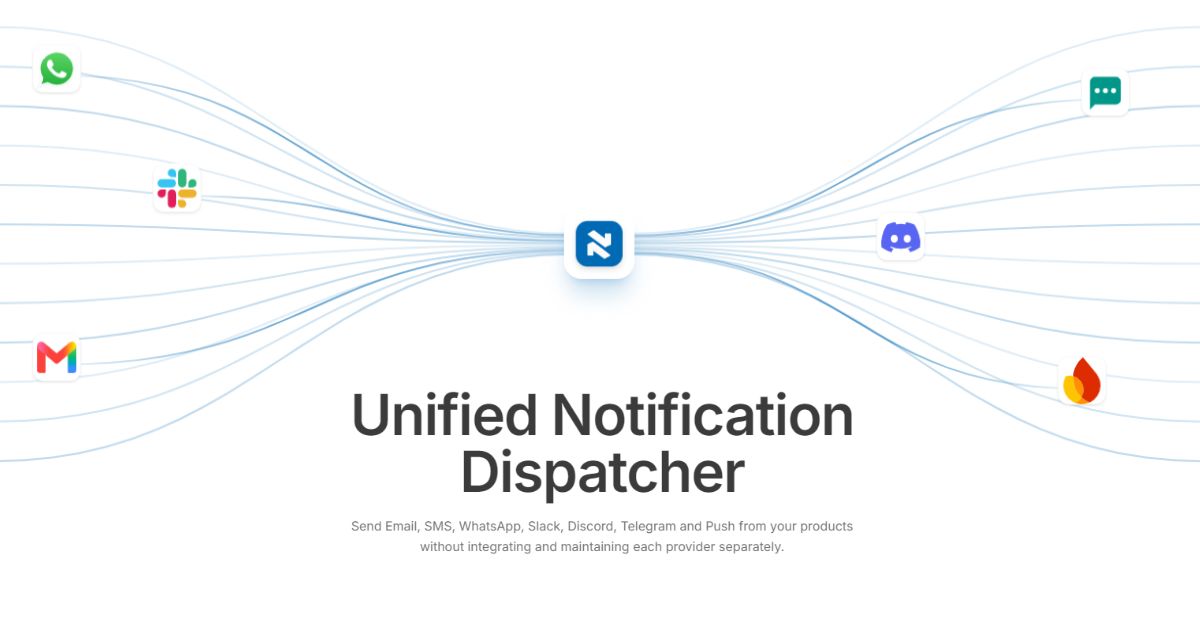
What It Is
When building multiple SaaS products and custom dashboards for clients at DOTIX, a frustrating pattern kept repeating: every single application needed to send notifications to users, admins, or internal teams.
In each new project, we were forced to re-integrate the same SMS providers, email APIs (SendGrid/Resend), WhatsApp business bots, push notification services, and webhooks. Worse, every dashboard had to individually handle delivery retries, rate limits, network timeouts, delivery logging, and secret rotation.
I conceived and built Notix to solve this bottleneck permanently. Now, any dashboard or backend service makes one simple API call, and Notix handles the entire multi-channel fanout, queuing, reliability, and logging in the background.
What It Does
- Single Dispatch API: Applications send a standard JSON payload specifying the alert content and intended target channels (e.g.
["email", "whatsapp", "sms"]). - Multi-Channel Bursting: One event (such as a payment receipt or critical security warning) can be dispatched concurrently across Email, SMS, WhatsApp, and Webhooks without the client app needing multiple SDKs.
- Asynchronous Queue & Auto-Retry Engine: If a downstream provider fails or is rate-limited, Notix queues the message in Redis and retries with exponential backoff rather than dropping the alert or hanging the client application.
- Centralized Audit & Delivery Logs: Complete observability into message status (queued, delivered, bounced, failed) across all channels from a single dashboard.
Architecture & My Contribution
I solely originated, architected, and engineered Notix to serve as an internal and B2B platform:
-
Gateway Design & Unified Schema:
- Standardized notification templates and recipient resolution into a clean, intuitive REST contract.
- Built a provider abstraction layer so switching email or SMS providers behind the scenes requires zero code changes in client applications.
-
Resilient Background Processing:
- Used Redis queues and worker threads to decouple API ingestion from provider dispatching, keeping client HTTP responses sub-50ms.
- Built robust fallback logic (e.g., if WhatsApp delivery fails or is unreachable, optionally fall back to SMS).
-
Rate Limiting & Cost Controls:
- Implemented tenant-level throttling to prevent rogue loops from exhausting third-party API quotas or incurring accidental provider charges.
-
Product Leadership & Client Adoption:
- Integrated Notix across all internal DOTIX SaaS projects and rolled it out as an infrastructure service for client development contracts.
Skills Used & Developed
- System Design & API Gateway Patterns: Decoupled architecture, clean provider abstraction, and fault tolerance.
- Distributed Queuing & Reliability: Redis worker queues, exponential backoff, dead-letter queues, and idempotency keys.
- Multi-Channel Protocol Integration: Mail transfer agents (SMTP/API), WhatsApp Cloud/Web APIs, Twilio/SMS APIs, and webhook dispatchers.
- Observability: Centralized log streaming and delivery status tracking.
Key Learnings & Takeaways
- Notice internal friction early: If your engineering team writes the same integration code three times across different repositories, it's time to extract it into a dedicated microservice or platform.
- Decouple notification delivery from transactional flows: Never let a slow or failing third-party email provider block a critical checkout or user sign-up response. Ingest immediately, respond fast, and queue delivery in the background.
Skills & Technologies